

If you didn’t finish high school, you’ve likely asked yourself: Should I get a GED or earn a high school diploma?
Both options can help you move forward in education and career opportunities, but they are not the same. Understanding the differences between a GED (General Educational Development) credential and a high school diploma is essential before making a decision.
This guide explains the key differences, pros and cons, costs, college acceptance, employer preferences, and which option might be best for your goals.

What Is a GED?
The GED is a high school equivalency credential awarded after passing four subject exams:
- Mathematical Reasoning
- Reasoning Through Language Arts
- Science
- Social Studies
Instead of completing coursework over several years, you demonstrate high school-level knowledge by passing standardized tests.
Who Is the GED For?
The GED is designed for:
- Adults who did not complete high school
- Individuals who need a faster path
- People balancing work or family responsibilities
- Those confident in self-study
Most states require test-takers to be at least 16–18 years old.
What Is a High School Diploma?
A high school diploma is awarded after completing required coursework and earning a specific number of credits over time.
You must complete subjects such as:
- English
- Math
- Science
- Social Studies
- Electives
For adults, diplomas can be earned through:
- Adult education programs
- Online high schools
- Credit recovery programs
- Community education centers
Unlike the GED, a diploma reflects completed coursework rather than a single test.
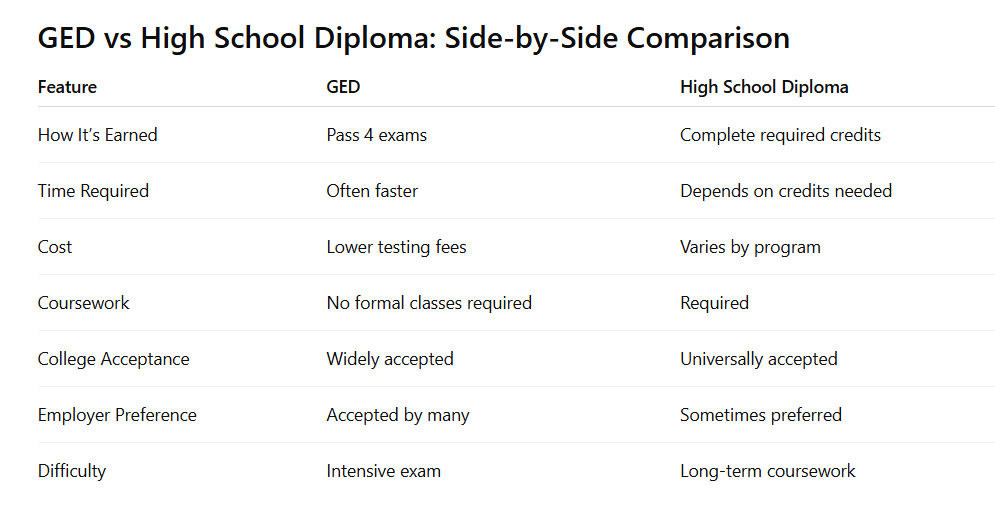
Which Is Better: GED or High School Diploma?
There is no universal “better” option. The right choice depends on your goals.
Choose the GED If:
- You want the fastest completion option
- You are comfortable with standardized testing
- You need a credential quickly for employment
- You prefer self-study
Choose a High School Diploma If:
- You want broader college opportunities
- You struggle with high-pressure exams
- You want a traditional education credential
- You need stronger academic preparation
Do Employers Prefer a Diploma or GED?
Most employers accept both credentials. However, some employers view a high school diploma as slightly more favorable because it reflects long-term coursework and classroom participation.
That said, in many industries, once you gain work experience, employers focus more on skills and experience than the credential itself.
College Acceptance: GED vs Diploma
Most community colleges and many universities accept both GED and high school diplomas.
However:
- Competitive universities may prefer a traditional diploma
- GED holders may need additional placement testing
- Some colleges require minimum GED score thresholds
If college is your goal, research admission policies first.
Is the GED Harder Than High School?
This depends on the learning style.
The GED compresses four years of knowledge into four exams. That means:
- Strong test-takers may find it efficient
- Those who struggle with exams may prefer coursework
A diploma spreads learning across months or years, reducing exam pressure.
How Long Does It Take?
GED Timeline
- Preparation: 1–6 months
- Testing: 1–2 days (four separate exams)
High School Diploma Timeline
- Few missing credits: 3–6 months
- Several credits: 6–12 months
- Starting fresh: 12–24 months
Online and self-paced programs can accelerate diploma completion.
Cost Comparison
GED Costs
- Testing fees per subject
- Study materials (optional)
- Retake fees if necessary
Diploma Costs
- Public adult programs: Low-cost or free
- Online private schools: Tuition-based
- Credit recovery programs: Varies
The GED is usually the lower-cost option upfront.
Income Potential: Is There a Difference?
Studies show both GED holders and diploma graduates earn significantly more than individuals without credentials.

However:
- Some research suggests diploma holders may earn slightly more over time
- Career growth often depends more on further education and experience
The credential is a stepping stone not the final destination.
Can You Join the Military With a GED?
Yes, but:
- Diploma holders may have more enlistment opportunities
- GED holders may need higher test scores
- Requirements vary by branch
Always check current military policies.
Flexibility for Adults
Adults returning to education often prioritize flexibility.
GED Advantages
- Study at your own pace
- Minimal scheduling
- Faster completion
Diploma Advantages
- Structured support
- Teacher guidance
- Academic development
Online diploma programs now offer flexibility similar to GED preparation.
Common Misconceptions
“The GED Is Easier”
Not necessarily. It tests comprehensive knowledge in fewer sessions.
“A GED Isn’t Accepted Anywhere”
False. It is widely recognized across employers and colleges.
“A Diploma Takes Too Long”
Not always. Adults who already earned credits can finish quickly.
FAQs
Is a GED the same as a high school diploma?
No. A GED is an equivalency credential earned through testing, while a diploma requires completing coursework.
Do colleges prefer a GED or diploma?
Most accept both, but some competitive schools prefer a diploma.
Can you get a good job with a GED?
Yes. Many employers accept a GED, especially when combined with skills or experience.
Is the GED faster than earning a diploma?
Usually, yes. The GED can often be completed in months.
Which is better for adults?
It depends on career goals, timeline, and learning style.
Conclusion about GED vs High School Diploma
Both options provide a pathway forward. The right choice depends on:
- Your timeline
- Your academic strengths
- Your college or career goals
- Your financial situation
If speed and cost matter most, the GED may be the better fit.
If long-term educational flexibility and traditional recognition are priorities, a high school diploma may offer advantages.
The most important thing is not which credential you choose—but that you take the step to complete your education.